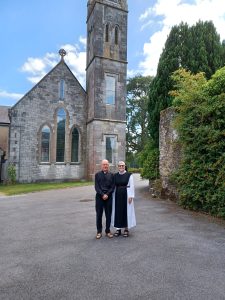
Visitors to Glencairn, Part II: Fr Chris
People come to Glencairn for all sorts of reasons. Some come for a retreat, some to volunteer, some for a few days of rest, and others find themselves spending a little longer within the rhythm of monastic life.
In this second instalment of our series on the people who visit and stay at Glencairn, we meet Fr Chris, a diocesan priest who spent the summer here between appointments. After five years on the staff at Maynooth, where he served as spiritual director to the seminarians, he is due to return to parish ministry in September.
Below is a conversation between Fr Chris and one of the nuns:
Could you tell us a little about yourself and your journey as a priest?
Well, I’m 35 years ordained, and I’m getting ready to start my twelfth appointment, which, while hardly a record, is more than most of my more settled colleagues! My first appointment was three years at the Cathedral after I was ordained. That was followed by three years of further study, then one year teaching in a seminary that closed after a year, after which I was sent to another seminary that closed after a year.
Then I was back in parish ministry for a total of ten years, in four different parishes, on two sides of the Atlantic. After that, it was back to Rome, where I served on the staff of the Pontifical Irish College. Happily, this third seminary didn’t close a year after I arrived!
After Rome, I was back in parish for eight years, then I was sent to Maynooth, where I spent the past five years as spiritual director to the seminarians. The earlier jinx has definitely been overcome, as Maynooth is going from strength to strength despite my years there!
So, how did you come to be here at Glencairn?
Very simple. I was appointed to Maynooth for five years, and my term finished this June, whereas my new appointment doesn’t begin until September 1st, which left me with time to do something different. I thought of travel, but nothing was really grabbing me, and I felt the need for a really good rest and a time of quiet and prayer. So here I am, since July 1st.
Why did you choose to come here for that time?
I’ve been here many times before, but hey have all been short visits. I just thought it would be a lovely place to come and rest and pray and do a little bit of writing. And it’s been just lovely. It has been more than I hoped for. And you, the community, are so friendly and hospitable.
Some priests might think it a strange choice to spend a sabbatical at a women’s monastery. Did you consider doing something more conventional?!
I did think of one or two possibilities. But over the years I’ve been involved, on and off, in academia, and I don’t want to just go and do a course. I didn’t find any tailor-made sabbatical programmes, and none of the possibilities I explored was really setting me alight. And so I thought, well, why don’t I try some monastic time! So I phoned Mother Fiachra, and when we spoke – God bless her generosity – I felt like I was pushing an open door.
You came with certain hopes for this time — rest, prayer, study and writing. Has anything about the experience surprised you?
I came with all sorts of very brave and stout-hearted resolutions regarding how deeply and intensely I was going to pray. I imagined that I was going to put in long, long periods of silence. That hasn’t happened to the extent I thought it would, and to my own surprise, I’m okay with that. Certainly, I’ve prayed, by the grace of God. Sharing in the Monastic Office has been a privilege, but the deep and intense side of things didn’t materialize in the way I thought it might. I hope that I’m not making excuses for lack of effort, but I really have a sense that the Lord has done the heavy lifting and that his intention for me has been to have a good rest. Again, I don’t want to seem like I’m making excuses for indolence, but my sense has been that the Lord has been okay with my going regularly to the coffee shop and reading over a coffee. It’s not that I haven’t prayed, but it hasn’t been with that intensity. A phrase from Psalm 131 comes to mind: ‘I have not gone after things too great, nor marvels beyond me.’ And again, let me say that I hope I’m not making excuses for mediocrity. I don’t think so, and I feel grateful for what I’ve received during this time.
As a diocesan priest, you’re accustomed to praying the Divine Office, often on your own. How has it been to experience the rhythm of prayer here at Glencairn?
It’s been slightly different for me this past five years, because in Maynooth, Lauds, Vespers and Compline are generally prayed in common, but here at the monastery, the rhythm of life is different; it’s different to seminary life, and it’s most certainly different to parish life. In parish, Mass times are scheduled, but after that, pretty much everything is much less routine, whereas in monastic life, everything revolves around the liturgical schedule. And, of course, around the meal schedule! When you’re cooking for many people, you don’t leave it to chance; you’d don’t rumble up something for a community of sisters and a guesthouse by going to the fridge and scratching your head. That would be parish life!
Between feeding the mind and feeding the soul, there’s a routine to life that just isn’t present in diocesan life. And that can be a great blessing, but that routine is somewhat alien to most diocesan clergy. We diocesan clergy try to give a framework to our days: for most of us, the best time to pray is in the morning, but of course Divine Office, or Liturgy of the Hours, also gives us a framework. But you do have to be pretty intentional about fitting it in to what can be a rather chaotic and bumpy schedule.
Do you find that difficult?
To be honest, I often feel really very grateful for the fact that the Liturgy of the Hours for clergy is compulsory. Making it so was a master-stroke, because if it weren’t, we’d let it go. With all the good will in the world, we’d respond to the immediate demands, and the Breviary would, more and more, take second, then third place. I’m fond of a nickname for the Breviary: ‘The Wife.’ After all, she comes everywhere with me… I’m not meant to leave her behind!
That’s quite funny, because it refers both to how much it is loved and to the fact that it is a big commitment!
Yes, a commitment. There’s a lovely phrase from Archbishop Robert Barron. When he was asked about the compulsory nature of the Breviary for priests, he said that when he is conscious that the day is moving on and he still has to do one or two parts of it, “it broods over my day.” I think that’s a wonderfully realistic attitude. As frail and often very busy people, we needn’t expect the loftiest motivation for every moment of prayer. Sometimes, praying from a sense of obligation is fine. For sure, it would be wrong of that were the only reason, but that sense of my Breviary obligation brooding over my day can be a decent and reliable motivator.
It’s good that the Breviary broods over the day; it’s good that the day isn’t quite complete until it’s complete. Life being what it is, there will be days we miss something, but I think we should at least cultivate the sense that those days lacked something. This is not about scrupulousness, but about cultivating a kind of motivation that knows and works with our frailty and our circumstances.
You’ve spent a significant amount of your priesthood in seminary work. What did you miss about parish life when you were in the seminary, and what do you think you will miss from seminary life when you return to parish?
When I was in seminary, what I missed most was presiding at Sunday Mass every week: presiding, preaching, meeting the people after Mass. That, for me, has been the high point of the week. In the seminary, we get to preside a few times a year, and it was important for me, as seminary Spiritual Director, to be there at other times also. So I missed the parish celebration of Sunday Mass each week.
Conversely, going back to parish — and I’ve had the experience of going back to parish from seminary before — I certainly missed the freedom to do a lot of reading and writing. I like to read. I don’t regard it as a hobby or a niche interest. I think that for priests, it needs to be more substantial than that. Granted, some of us are more inclined that others, but we all need to be readers, to some extent at least. So I hope that in my new appointment, I’ll manage to find a reasonable amount of time for reading and writing.
This isn’t your first transition from seminary life back to parish life. Do you think you’ll do anything differently this time?
To be honest, I really don’t know, because it’s a different experience of parish I’m going into. Where I’m going is a pretty large pastoral area. There will be two priests, and we have seven churches between us. Each of those churches, up till quite recently, had its own residential priest. In addition, I’ll be doing night cover, one night a week, for Wexford General Hospital.
From your experience here in the monastery, is there anything you’ve experienced that you would like to bring with you into parish life?
I would love, if I can, at least to some extent, bring back something of that sense of joy in the liturgy. At times that joy is palpable here, especially on a Sunday; also on the Solemnities. Recently, on the great monastic feast day of St Bernard, you just knew that there was something special happening. There was a soaring joy and beauty to the liturgy that day. You could walk into the chapel and you might be thinking: these Sisters, they’re praying all the time; it’s their routine; it’s what they do. But they haven’t fallen into any kind of staleness; even without particularly trying, there’s a new and fresh sense of joy.
Without wishing to blame or judge, I think a big challenge for Irish Catholicism will be to cultivate a more joyful liturgical style. It’s not, I think, unfair to observe that we tend to have a less-than-terribly-joyful way of celebrating our faith. That is something that, if there is to be deep renewal, will need to be looked at. We need to be fostering a deeper liturgical culture here in Ireland, in our parishes. All easier said that done, of course. A lot of priests are under a lot of pressure; a lot of men in the trenches are finding it heavy going. Personal joy can be challenging, and finding time for measures that modify our liturgical culture is also a challenge.
If would be counter-productive to get downhearted about not being joyful… we do what we can. And we allow for the fact that so many people who have a less than exuberant way of participating at Mass are utterly sincere and supportive. Even still, I think we can be saying to ourselves and to our people that maybe just a little more is being asked of us. After all, we are God’s chosen people, not God’s frozen people!
We priests also have to be mindful that we’re in a role of leadership, and we need to be emphasising, more and more, the reality of the sacred and reverence for the sacred. And we need to be aware, and catechizing our people, that this is not just a community celebration, where the primary purpose of the Mass is to affirm our identity as this local community. That’s not the purpose of the Mass; the Mass is universal. The identity of the local community can be affirmed in many, many ways, but that affirmation is not what the Mass is about. Our community’s identity will not – and certainly should not – suffer if, with the decline in the number of priests, we need to go to a neighbouring parish for Mass at least some of the time.
Looking ahead to parish life, how do you think vocations can be fostered?
To start I think we should bear in mind that when it comes to priestly or religious vocation, by definition God is the one who does the calling. I really don’t believe that there is a technique for promoting vocations. I don’t think there is a publicity machine or an app or a website that can do a whole lot more than any traditional noticeboard. At its most fundamental, vocations promotion requires evangelisation, and the fundamental task for the Church across the board in Ireland today is precisely evangelisation.
We have to be evangelising. We need to know what the fundamental message is. We priests need to be up-skilled. We need to know what the kerygma is. We need to be able to proclaim it simply. We need to know, and believe, and feel, that we are evangelists. So many of us just weren’t trained to do that.
What would you feel you personally need to be up-skilled in, and how might that happen?
One of the blessings of my last five years was presenting a course on evangelisation to seminarians, for a full year. To me, it was very, very enriching. I would love to share that, and to help people towards the kind of faith synthesis that will enable them – and give them the desire – to evangelize.
Let’s bear in mind, too, that the primary role of the priest is not administration, but proclamation. And it was St Pope Paul VI who wrote that the Church ‘exists in order to evangelize.’
It’s the Lord’s Church, and if the Gospel works, then we need to be talking about the Gospel. But it sometimes seems that the message takes second place to the structures, and even how we discuss structures sometimes seems to owe more to contemporary philosophical obsession with issues of power. Sometimes I think we’re imbibing more of the spirit of post-modernism than the Spirit of Christ. If we spend more time on issues like that, we’re missing the point. The big question – in one sense the only question that really matters – is: Here is our faith, how can we share it?
From pastoral experience, any priest can tell you that there is huge crisis and confusion regarding sexuality; there is anxiety, angst and depression pervading the lives of so many of our youngsters. We need to be addressing such matters, proclaiming the better vision that our faith offers us, rather than wrangling over who is, or who appears to be, in charge. We have the Good News, which means that we have a better story about what it is to be human beings. The world is waiting for that.